
How Much Weight Can You Lose on Tirzepatide? What the Trials Show
Medically reviewed by Dr. Amin · Last updated 19 October 2026
Quick answer: In the largest clinical trial of tirzepatide for weight management, adults lost an average of 15% to 21% of their body weight over 72 weeks, depending on the dose, compared with 3% on placebo. Results vary a lot between people. Most of the weight tends to come back if treatment stops, so it works best as a long-term plan made with a doctor.
How much weight do people lose on tirzepatide?
The main evidence comes from the SURMOUNT-1 trial, which followed 2,539 adults living with obesity (without diabetes) for 72 weeks. Everyone also received advice on eating and activity. The average change in body weight was:
- 5 mg weekly: -15.0%
- 10 mg weekly: -19.5%
- 15 mg weekly: -20.9%
- Placebo: -3.1%
To put that into kilograms: the average starting weight in the trial was about 105 kg, so a 20% loss is roughly 21 kg. For someone starting at 80 kg, the same percentage would be about 16 kg. These are averages, not promises. Some people lost much more, and some much less.
What share of people lose a meaningful amount?
Most people in the trial lost a clinically meaningful amount:
- At least 5% of body weight: 85-91% of people on tirzepatide, compared with 35% on placebo
- At least 20% of body weight: 50% on the 10 mg dose and 57% on the 15 mg dose, compared with 3% on placebo
A loss of 5-10% may sound modest, but it is the range in which doctors usually start to see improvements in blood sugar, blood pressure and joint pain.
How fast does the weight come off?
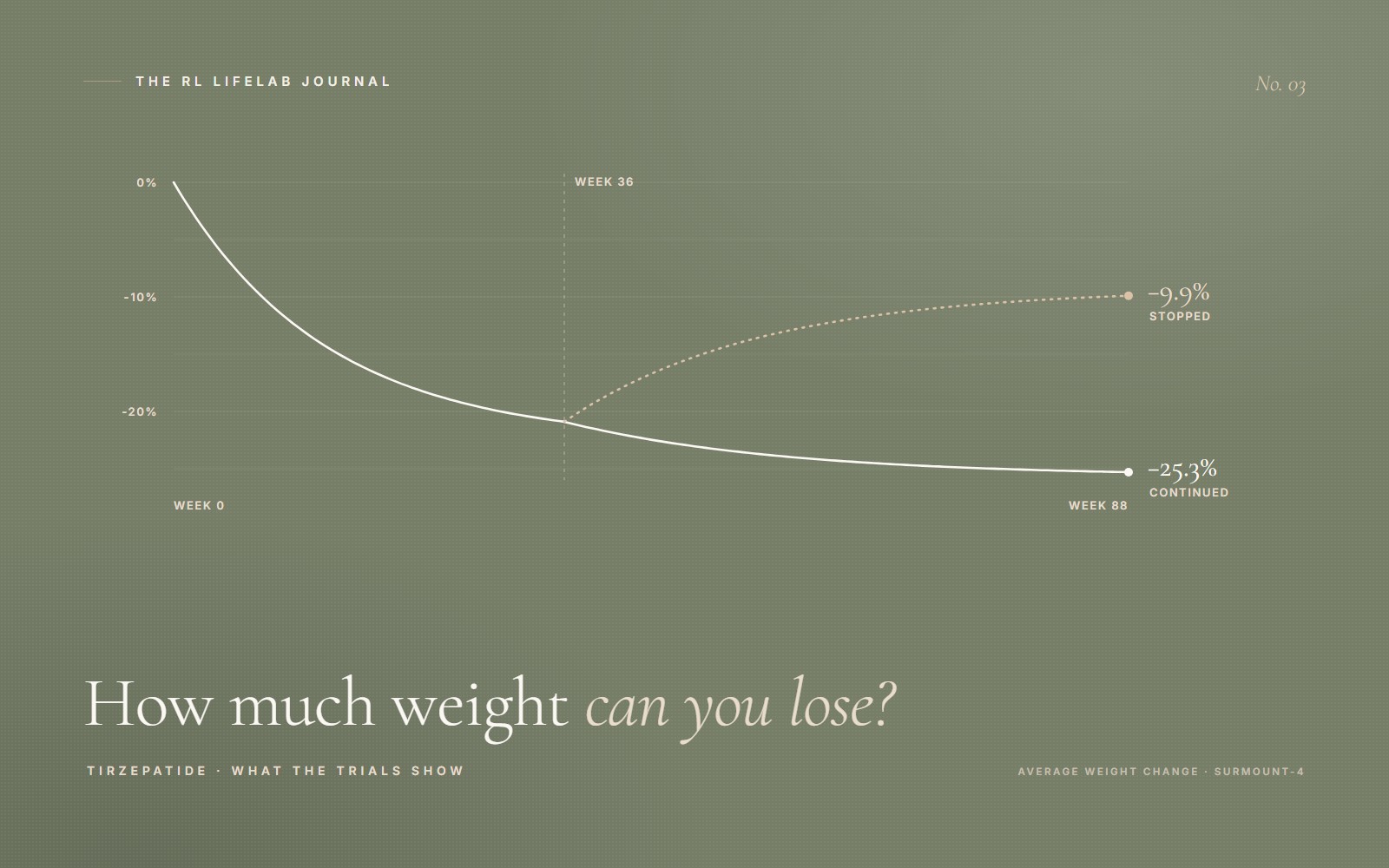
Weight loss is gradual, not overnight. Treatment usually starts at a low dose that is increased step by step every few weeks, so the effect builds over the first months. In the SURMOUNT-4 trial, people who completed the first 36 weeks on the highest dose they could tolerate had lost an average of 20.9% of their body weight by that point.
A realistic way to think about it:
- First weeks: appetite drops and small changes appear while the dose is still low
- The following months: losses usually build steadily as the dose reaches its maintenance level
- After about a year: weight loss slows and levels off, which is normal, not a sign that it has stopped working
Does the weight loss last?
It can, as long as treatment continues. In a three-year follow-up of SURMOUNT-1 in people who also had prediabetes, the average weight loss at 176 weeks was still 12.3% to 19.7% depending on dose, compared with 1.3% on placebo. Fewer people on tirzepatide developed type 2 diabetes during that time: 1.3%, compared with 13.3% on placebo.
What happens if you stop tirzepatide?
This is the part many people do not expect. In the SURMOUNT-4 trial, everyone took tirzepatide for 36 weeks and lost an average of 20.9%. Then half switched to placebo without knowing it:
- People who continued treatment lost a further 5.5% over the next year
- People who stopped regained an average of 14% of their body weight
- 89.5% of those who continued kept at least 80% of their weight loss, compared with 16.6% of those who stopped
Obesity behaves like a long-term condition, such as high blood pressure. When the treatment stops, the body's appetite signals tend to return. Any plan to reduce or stop treatment should be made with your doctor, alongside a plan for eating and activity.
What affects how much weight you lose?
- Dose: in the trials, higher maintenance doses led to more weight loss on average
- Staying on treatment: consistency over months matters more than the first few weeks
- Eating and activity: every trial combined treatment with diet and exercise advice
- Starting point and health: people with type 2 diabetes tend to lose somewhat less weight than people without
- Side effects: digestive side effects can limit how quickly the dose is increased
Protect your muscle as you lose weight
When weight comes off quickly, some of it can be muscle rather than fat. Aim for enough protein at each meal and include strength exercise, such as resistance bands, weights or bodyweight exercises, two to three times a week. Your doctor can advise what suits you.
Frequently asked questions
How much weight can you lose on tirzepatide in a month?
It varies too much to give one number. Treatment starts at a low dose and increases gradually, so the first month is usually the slowest. Clinical trials report results over many months, with average losses of 15-21% of body weight over 72 weeks.
Is tirzepatide weight loss permanent?
Not automatically. In the SURMOUNT-4 trial, people who stopped treatment regained an average of 14% of their body weight within a year, while people who continued kept losing weight.
Why has my weight loss slowed down?
Slowing down and levelling off after many months is expected. In the trials, most weight loss happened in the first year. If you are concerned, speak to your doctor rather than changing your dose yourself.
Do I still need to diet and exercise?
Yes. In every major trial, tirzepatide was combined with advice on eating and physical activity. Good habits also help protect muscle and make results easier to keep.
Is tirzepatide right for me?
That depends on your health history, your other medicines and your goals. It is a prescription medicine, so the decision should be made with a doctor.
The bottom line
- In clinical trials, adults lost an average of 15-21% of body weight over 72 weeks, depending on dose.
- Weight loss is gradual and usually levels off after about a year.
- Results last while treatment continues. Most people regain weight after stopping.
- Eating well, staying active and protecting muscle matter as much as the medicine.
Read more: Tirzepatide Side Effects: What's Normal and When to See a Doctor and Tirzepatide vs Retatrutide: What's the Difference? If you have questions about your own situation, take our free wellness assessment or book an online consultation with a doctor.
This article is for general education only and is not medical advice. Individual results vary. It does not replace a consultation with a qualified doctor.
References
- Jastreboff AM, et al. Tirzepatide Once Weekly for the Treatment of Obesity (SURMOUNT-1). N Engl J Med. 2022;387:205-216. doi:10.1056/NEJMoa2206038
- Aronne LJ, et al. Continued Treatment With Tirzepatide for Maintenance of Weight Reduction in Adults With Obesity (SURMOUNT-4). JAMA. 2024;331:38-48. doi:10.1001/jama.2023.24945
- Jastreboff AM, et al. Tirzepatide for Obesity Treatment and Diabetes Prevention. N Engl J Med. 2025;392:958-971. doi:10.1056/NEJMoa2410819