
Tirzepatide vs Retatrutide: What's the Difference?
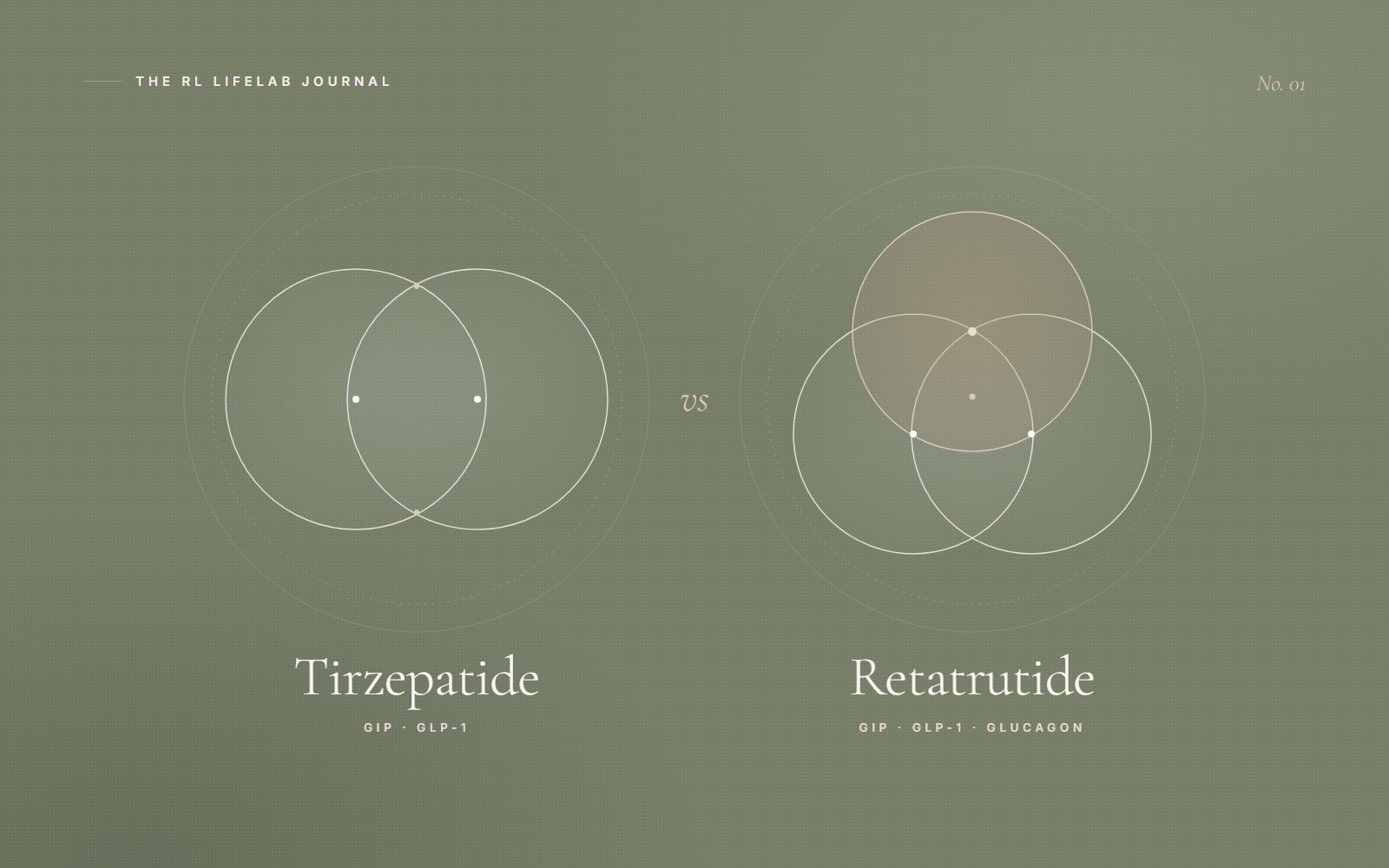
If you have been reading about weight-management injections, two names keep coming up: tirzepatide and retatrutide. Both are once-weekly injections from the same family of medicines. But they are at very different stages, and they work in slightly different ways.
Here is a plain-language guide to what each one is, what the research actually found, and what to ask your doctor.
The short answer
- Tirzepatide acts on two gut-hormone receptors (GIP and GLP-1). It has been tested in large phase 3 trials involving thousands of people, and it is approved as a prescription medicine in several countries, including the US and the EU.
- Retatrutide acts on three receptors (GIP, GLP-1 and glucagon). It is newer and is still being studied in clinical trials.
How they work, in plain words
After you eat, your gut releases hormones called GLP-1 and GIP. They tell your brain you are full, slow down how quickly your stomach empties, and help your body manage blood sugar. Tirzepatide copies the action of both hormones.
Retatrutide adds a third target: the glucagon receptor. Glucagon is thought to increase how much energy the body uses and how the liver handles fat. That third target is the main reason researchers are interested in it.
What the research found
Tirzepatide: the SURMOUNT-1 trial
This trial followed 2,539 adults living with obesity (without diabetes) for 72 weeks. Everyone also received advice on diet and physical activity. The average change in body weight was:
- 5 mg weekly: -15.0%
- 10 mg weekly: -19.5%
- 15 mg weekly: -20.9%
- Placebo (no active drug): -3.1%
Retatrutide: the phase 2 trial
This smaller trial followed 338 adults living with obesity for 48 weeks. The average change in body weight was:
- 1 mg weekly: -8.7%
- 4 mg weekly: -17.1%
- 8 mg weekly: -22.8%
- 12 mg weekly: -24.2%
- Placebo: -2.1%
Larger phase 3 trials of retatrutide are now being published. In one, involving 537 adults with type 2 diabetes over 40 weeks, average weight change ranged from -11.5% to -15.3%, depending on the dose.
Why you cannot compare the numbers directly
It is tempting to look at "24%" against "21%" and pick a winner. Don't. These were different trials, with different lengths, different people and very different sizes. The retatrutide phase 2 trial was small, and no trial has yet tested the two side by side. These are also averages: some people lose much more, some much less.
Side effects
For both medicines, the most common side effects are digestive:
- Nausea
- Diarrhoea
- Vomiting
- Constipation
In the trials these were mostly mild to moderate and happened mainly while the dose was being increased. That is why doctors usually start low and increase slowly. In SURMOUNT-1, between 4% and 7% of people on tirzepatide stopped because of side effects, compared with 2.6% on placebo.
In the retatrutide trial, a lower starting dose reduced digestive side effects. Researchers also saw a rise in heart rate that peaked at around 24 weeks and then eased. Because retatrutide is still being studied, its long-term safety is not yet known.
Who should not start without specialist advice
- Anyone who is pregnant, breastfeeding or planning a pregnancy
- Anyone with a personal or family history of medullary thyroid cancer or MEN2 syndrome
- Anyone who has had pancreatitis or gallbladder problems
- Anyone taking insulin or other diabetes medicines, because the dose may need adjusting to avoid low blood sugar
So which one is right for me?
An article cannot answer that, and neither can a friend's results. The right choice depends on your health history, your other medicines, your blood results and your goals. It is a conversation to have with a doctor who knows your situation.
If you are not sure where to start, you can take our free wellness assessment or book an online consultation with a doctor.
The bottom line
- Tirzepatide has more evidence behind it and is approved in several countries.
- Retatrutide has shown promising early results but is still being studied, and its long-term safety is not yet known.
- Neither is a shortcut. In the trials, both were used alongside changes to eating, activity and lifestyle.
- Always speak to a doctor before starting any prescription medicine.
This article is for general education only and is not medical advice. It does not replace a consultation with a qualified doctor.
References
- Jastreboff AM, et al. Tirzepatide Once Weekly for the Treatment of Obesity (SURMOUNT-1). N Engl J Med. 2022;387:205-216. doi:10.1056/NEJMoa2206038
- Jastreboff AM, et al. Triple-Hormone-Receptor Agonist Retatrutide for Obesity: A Phase 2 Trial. N Engl J Med. 2023;389:514-526. doi:10.1056/NEJMoa2301972
- Bajaj HS, et al. Efficacy and safety of retatrutide in people with type 2 diabetes (TRANSCEND-T2D-1): a phase 3 trial. Lancet. 2026;407:2402-2413. doi:10.1016/S0140-6736(26)00967-0